

The Hidden Danger in Your Kitchen Drawer: Why 14,000 Families Are Trashing Their Black Plastic Spatulas This Month
If you've ever watched a nylon spatula melt into your eggs or wondered why your family is suddenly anxious about microplastics, read this before you cook another meal.
For years, we were told that as long as our kitchen utensils were "BPA-free," we were safe. We bought the cheap, black nylon spatulas. We bought the colourful silicone sets. We trusted that if it was sold in a supermarket, it wouldn't hurt our families.
Then the studies started coming out.
It started with a now-famous paper revealing that just one five-centimetre scratch on a Teflon pan releases up to 2.3 million microplastics directly into your food [1]. Then came the reports of microplastics being found in human arterial walls, in testicles, and even a "credit card's worth" in the brains of 45-to-50-year-olds [2].
But the most alarming discovery wasn't about the pans. It was about what we were using to stir the food inside them.
Recent investigations have uncovered that many black plastic kitchen utensils are manufactured using recycled electronic waste [3]. That means the spatula you use to flip your toddler's pancakes could contain the exact same cancer-causing flame retardants and heavy metals originally used to coat computer keyboards and television casings.

"I have a nylon spatula that just melted cooking some eggs on a relatively low heat. Of course I threw all the food away. But I'm a single mother of two young children, and I've recently been reading a lot about how microplastics are basically killing everyone slowly. I'm trying not to have a total breakdown." — shared by one mother in a recent online health forum
The "Safe" Alternatives That Aren't
When the panic over black plastic hit, millions of families tried to pivot.
They tried cheap silicone, only to learn that when heated to high temperatures, low-grade silicone can leach siloxanes (D4, D5, and D6) — known endocrine disruptors — directly into hot meals [4].
They tried "eco-friendly bamboo" plates and spoons, only to discover that many discount brands use melamine — a hidden plastic resin — as a binder to hold the bamboo dust together.

"I tried replacing everything. I got rid of the Teflon. I threw out the nylon spoons. But either the replacements cost a million dollars, everything sticks to them, or you find out a year later that they're leaching a completely different set of 'forever chemicals' like PFAS or BPS. I just don't want to be concerned about chemicals getting into my food and getting some crazy cancer. I just want peace of mind." — another frustrated parent
What nobody tells you — what the $30 billion cheap kitchenware industry actively tries to suppress — is that the solution to toxic modern cookware isn't a new synthetic compound. It's a return to the only material that has been proven safe for centuries.
The Unique Mechanism: Why Wood is Actually Safer Than Plastic
For decades, a pervasive myth kept families clinging to their plastic spatulas: the belief that wooden utensils harbor dangerous bacteria.
"My husband was adamant that wood boards and spoons cannot be sterilized properly. He thought the plastic was cleaner." — one user
This is scientifically backwards.
Dr. Dean Cliver, a prominent food safety researcher at UC Davis, conducted extensive studies comparing plastic and wood in the kitchen [5]. What he found completely inverted conventional wisdom.
When you use a plastic spatula or cutting board, your knife or the edge of the pan creates microscopic cuts in the plastic. Bacteria become trapped in these micro-cuts, where they are almost impossible to wash out, even in a dishwasher. They sit there, multiplying, until your next meal.

Properly crafted hardwood, however, operates on a completely different biological principle known as Non-Porous Hardwood Integration.
Hardwoods possess natural capillary action. When bacteria land on a high-quality wooden spoon, the wood's natural capillaries pull the bacteria down beneath the surface, where they are trapped, deprived of oxygen, and naturally killed.
"Wood scientists have known this for years. Hardwoods give you that capillary action. The bacteria doesn't form. The knife cuts in plastic trap bacteria; wood naturally neutralises it." — a materials expert
The "Buy Once, Buy Well" Solution
This biological reality — combined with the terrifying rise in microplastic exposure — has sparked a massive migration back to premium wooden utensils. But not all wood is created equal.
To achieve the antibacterial capillary action without splintering or absorbing food odors, the wood must be a dense, non-porous hardwood, crafted without toxic glues or chemical varnishes.
This is why over 14,000 health-conscious families have recently switched to Hälsa Trä.

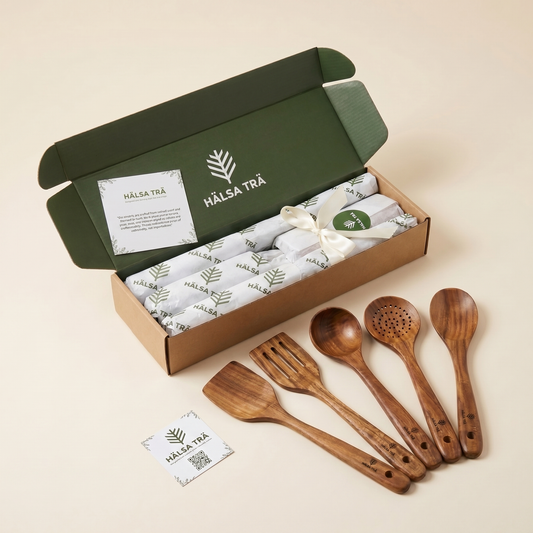
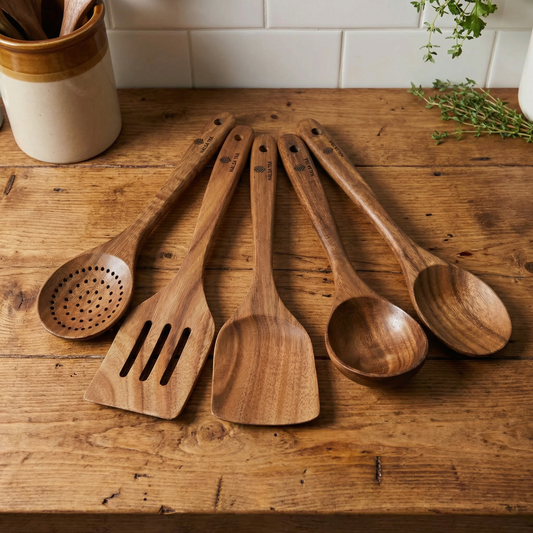
Crafted from premium, sustainably sourced teak, Hälsa Trä utensils are designed specifically to replace the toxic plastics in your kitchen. They are naturally non-porous, naturally antibacterial, and completely free from the flame retardants, PFAS, and microplastics leaching from cheap nylon and silicone.
| Feature | Hälsa Trä Teak Wood | Black Plastic / Nylon | Cheap Silicone |
|---|---|---|---|
| Microplastic-Free | ✓ Yes | ✗ No (Sheds into food) | ✗ No |
| No E-Waste Flame Retardants | ✓ Yes | ✗ No | ✓ Yes |
| Naturally Antibacterial | ✓ Yes (Capillary action) | ✗ No (Harbors bacteria in cuts) | ✗ No |
| Heat Safe (Won't Melt) | ✓ Yes | ✗ No (Melts easily) | ✗ Leaches siloxanes at high heat |
| Toxic Glue / Varnish Free | ✓ Yes | ✗ No | ✗ No |
View the 5-Piece & 8-Piece Sets
"No More Nasty Plastic in Our Food"
The transition away from toxic kitchenware isn't just about physical health; it's about the mental relief of knowing you aren't accidentally poisoning your family.
"We are slowly making the switch in our house to low-tox products. No more nasty plastic or silicone in our food. We now have our house motto: 'Buy once, buy well.' Just like my grandparents did." — Tracey, a verified Hälsa Trä customer
"I love that they're completely non-toxic and plastic-free, especially when cooking for my family. It gives me total peace of mind." — Paula Liggins, another verified buyer
Unlike the cheap, splintering bamboo utensils found in discount stores, Hälsa Trä's teak construction means they are an investment designed to last a lifetime. They won't scratch your expensive pans, they won't melt into your eggs, and most importantly, they won't slowly accumulate in your body.
"Not to sound outrageously fake, but this is the type of set that my kids will remember when they are older. It gives those nostalgic Nanna's kitchen vibes." — customer Juliet Powick
Verified customer reviews
The Hälsa Trä Promise
Right now, Hälsa Trä is offering a limited-time discount for readers who find this page, as part of their mission to help families transition to low-tox kitchens.
Choose the set that fits your kitchen: the Original 5-Piece Set for everyday cooking, or the Complete 8-Piece Set for greater versatility. Both are crafted from premium teak and protected by the same Hälsa Trä Promise.
However, due to recent viral news coverage regarding microplastics and e-waste in black spatulas, stock of premium teak is extremely limited. The company cannot guarantee availability after today.

Every order is protected by The Hälsa Trä Promise: Try the utensils in your own kitchen for 180 days. If you don't feel a profound sense of relief and total peace of mind cooking for your family, simply contact them for a full refund. No questions asked.
If protecting your family from hidden kitchen toxins matters to you, don't wait until another spatula melts into your dinner.
Choose Your Hälsa Trä Set
[1] Luo, Y. et al. (2022). Microplastic and PTFE contamination of food from cookware. Science of the Total Environment.
[2] Nihart, A.J. et al. (2025). Bioaccumulation of microplastics in decedent human brains. Nature Medicine.
[3] Turner, A. (2018). Black plastics: Linear and circular economies, hazardous additives and marine pollution. Environment International. See also: Liu, M. and Venier, M. (2024). Flame retardants in black plastic household products. Chemosphere.
[4] Zhu, J. et al. (2025). Silicone bakeware as a source of human exposure to cyclic siloxanes. Environmental Science & Technology.
[5] Cliver, D. O. (2006). Cutting Boards in Salmonella Cross-Contamination. UC Davis Food Safety Laboratory. See also: Ak, N.O. et al. (1994). Cutting Boards of Plastic and Wood Contaminated Experimentally with Bacteria. Journal of Food Protection.
-
 SAVE 20%
Hälsa Trä Natural Wood Utensil Set
Regular price £39.99Regular price £39.99 Sale priceUnit price per£50.0020% -
Hälsa Trä Natural Wood 8 Piece Utensil Set
Regular price £64.99Regular price £64.99 Sale priceUnit price per£79.9918%

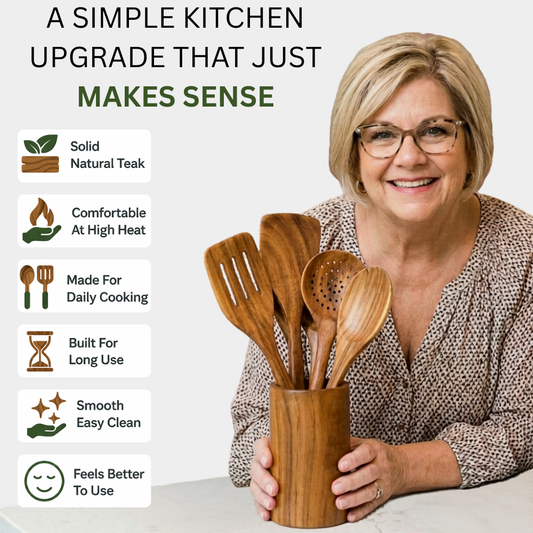
Why 600+ Home Cooks Rate It Five Stars
★★★★★ Verified Buyer Reviews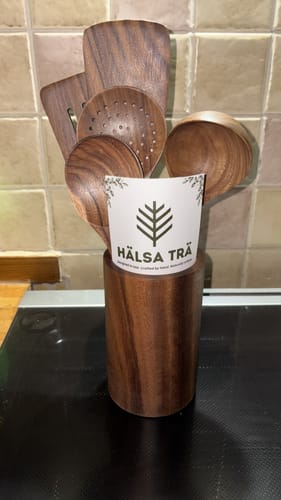
So pleased with my new utensils. All my friends comment on how stylish and good quality they are. So very much better than the plastic, 100% safer and better for the environment too! I’ll be collecting more soon!
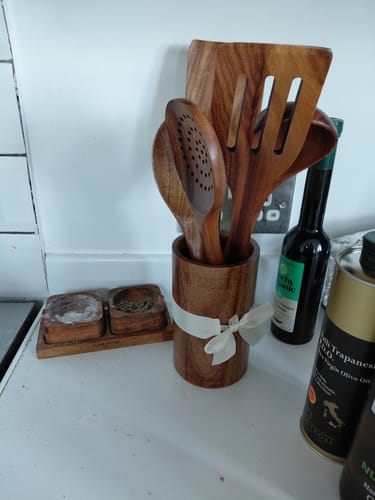
A great way to keep your favourite wooden utensils all in once place and ready to use. No more rummaging around in the draws.
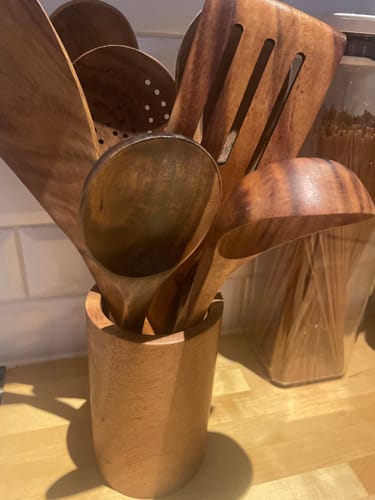
We absolutely love these utensils. It gives me confidence that I won’t scratch my pans and they look great too
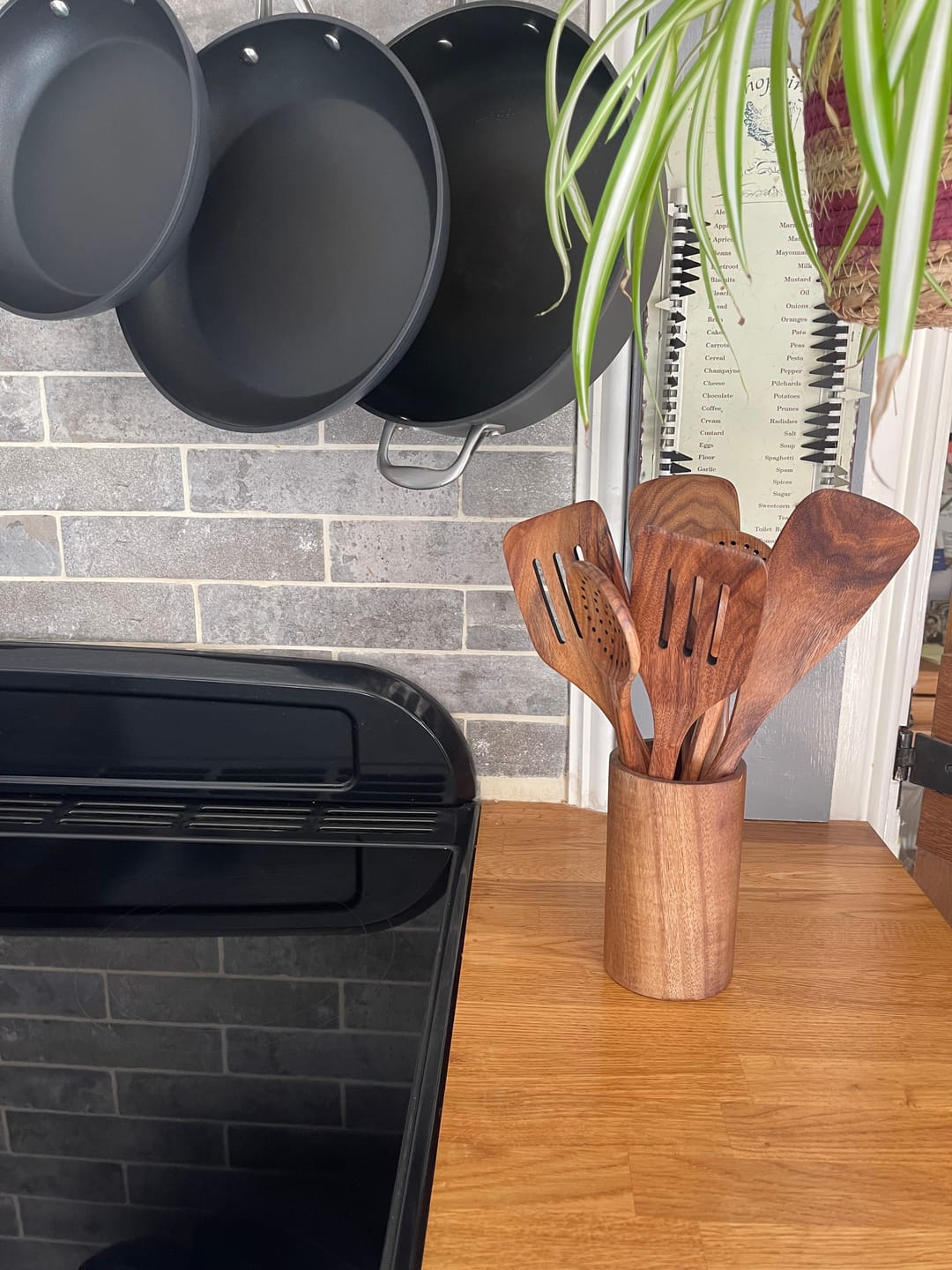
Beautiful utensils that look fabulous on my worktop and are a pleasure to cook with.
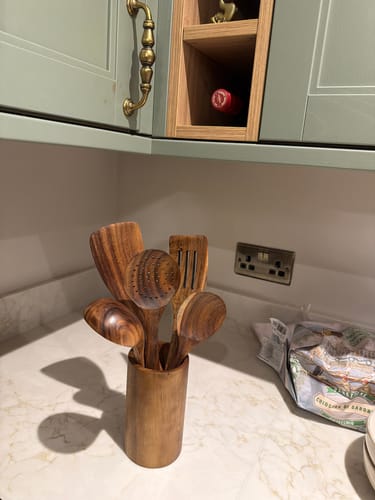
We received our first set and it had a chipped item. When I contacted the company they responded immediately asked for a photograph and quickly dispatched a whole new set. This was exceptional service and we are very happy with the product. Feel much better about cooking with these utensils
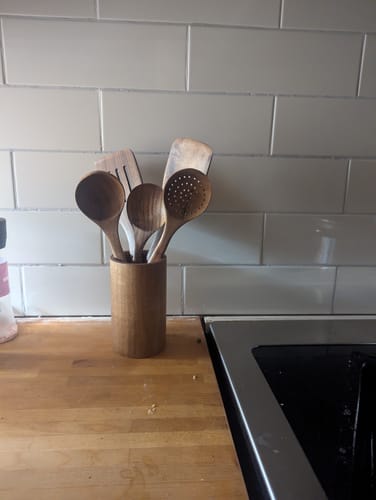
I’m really impressed with the quality of these utensils, wish I’d bought them sooner.
✓ Free wood holder ✓ Free tracked shipping ✓ 180 day risk free